I am going to start with the assumption that we can generally take the things adolescence tells us directly as fact. I think that this is definitely debatable: the show and movie don’t work neatly together at all, and there are as many issues with seeing adolescence as a retelling as there are with seeing it as a sequel. I’m working off my theory about adolescent’s place in the timeline, which is that it’s a sequel taking place in the semi-unconscious space utena inhabits after falling out of ohtori, something which occurs when she has “graduated” into adolescence, but in a space which much less stable than the show and often rehashes events/questions, and in which anthy is more ‘awake’ and agentic than in the show. no matter how you see it, it’s clear that the perspective in adolescence is a bit more… grown up. there are far fewer euphemisms, and the characters (now visibly older) engage with sex in a much more direct way. it’s something they naturally seek out, not something forced on them by adults. the wool has been lifted off the narrative’s eyes, and so there are things which were only alluded to (or not even) in the show that can be said outright. this isn’t to say that the movie is overall “truer,” just that it is dealing with different distortions. some things in the movie are seen more clearly, and some are more clouded. the hard truths shine through (while they are repressed in the consciousness of the show) whereas mundane details (i.e. the architecture of the school, whether touga is literally or spiritually dead) are distorted. the show does give us an out to this total ambiguity, however: the most explicit insights are not seen or experienced by utena, but instead are told or (especially) seen on film. the story of adolescence may be unconscious, synthesizing the things utena is moving through in a fever dream, but it contains hard evidence of what was really going on. touga’s account of his sexual trafficking is one, and so are the tapes of akio and anthy.
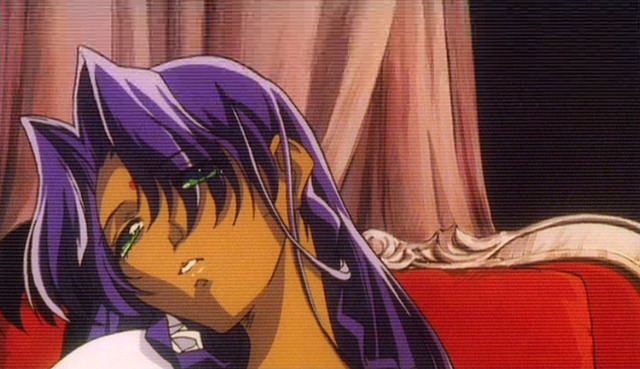
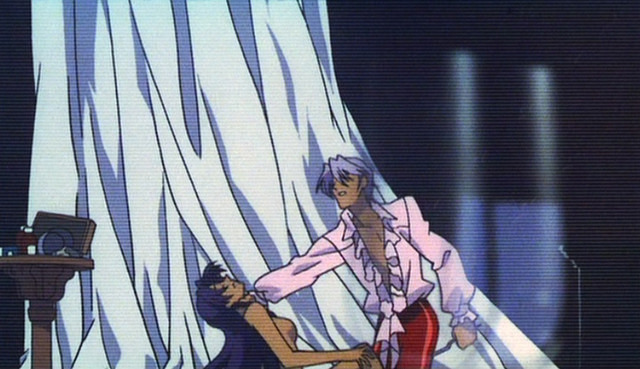
but I disgress. working from the assumption that adolescence gives us direct insight into the show, we can piece together a non-euphemismic story. following a traumatic bonding (maybe sexual, certainly instigated by anthy in response to an external threat to the safety of their siblinghood), both akio and anthy develop an incestual attachment to one another. at some point on the way to the present day, this manifests as akio regularly drugging anthy and raping her. unbeknownst to him, anthy isn’t actually drugged. this is a significant insight into the show, if we take it at face value: akio does not know that anthy knows he’s raping her. this puts his 'big brother’ act in a completely different perspective, since it means akio and anthy aren’t both in on a farce they’re performing for other people. instead, akio is lying to anthy (keeping his sexual abuse from her) while anthy is also lying to him (pretending she doesn’t know).
the drugs seem analogically related to anthy’s glasses. the scene where she leaves them at akio’s desk before walking out the door is, I believe, directly related to the one where he attacks her before falling off the balcony. very different tones/moods, different levels of agency given to anthy, but they are fundamentally both the moment when akio loses power over anthy, when he loses his “key” and so his life.
of course, they’re also very different scenes. it seems that in the movie anthy doesn’t intend to let akio know that she’s awake, and she wants things to continue as they are– it is akio who ends their relationship via attempted murder/suicide. in the show, anthy peacefully leaves him. for the sake of coherence, I would hypothesize that the final scene of the show is a too-tidy closing to anthy’s story needed to finish the series and is made non-canon by the more complex story of her escape in the movie.
Then, we might say that that the movie’s scene is what really happens to anthy after utena leaves: utena takes anthy from the coffin and makes it impossible for anthy to continue to hide her humanity from akio– anthy leaving the coffin is not really an entirely autonomous decision on her part, she is pulled out of it. she wishes to remain with her prince (begging akio to stay with her, take the power she believes his princehood gives him over her) but now that she is awake, that’s impossible and akio must die. he cannot live without her, because his real self died back when they were children, and he has been sustained by the power he has wrongly taken from her. seeing that the power he thought he had (to use her without her knowing) is actually power she had over him (to allow him to use her without him knowing) is the end of that.
for anthy, akio’s death is the confirmation of what happened when she was removed from her coffin. she cannot go back to the false world she lived in before utena freed her: she has the key and she must use it to escape. and she does, slowly: adolescence is the story of anthy learning what sex is between consenting parties. it is one of give and take, one where people cannot be “won” through sex (as seen in the scene in utena’s room) even if they want you, one where you must be vulnerable (as seen in the drawing scene) as they are vulnerable to you. in order for her to truly have sex with utena, utena must see the hole in her chest that men have inflicted onto her. to be honest, I think that all of the sex scenes between utena and anthy in adolescence are shockingly beautiful: sensual and tender and unflinching. I also appreciate that utena never takes a role of authority. she isn’t some manic pixie dream girl, come to tell anthy how to have sex– she doesn’t know! but she gives anthy the space to be intimate and vulnerable, she’s honest, she’s open and wants her. she says I’m sorry for lashing out, I was afraid but you were good to touch me and that gives anthy the floor. the key.
of course, there are many, many questions left unanswered. the scene where utena turns into a car is virtually identical to the one in which she falls out of the world: is it the same scene, or a second, later event which mirrors the first one? where does the show take place? why does shiori have such a large role and why does she turn into a car, of all the characters? what is going on with the kiryuu siblings (some thoughts on this at the bottom of the post)? etc etc
I do think that part of the difficulty of analyzing rgu/adolescence is that it exists within a nesting doll of analogies. euphemisms abound, but it’s difficult to decide what is the “bottom”– is akio drugging anthy what happens in the “real world” (an idea supported by the fact that it is on film, a 'real’ medium) or is it a physical analogy for their general dynamic? I don’t think we’ll ever know, and I also don’t know that it matters.
(side note about touga’s death: I really go back and forth between whether this is “true” or not. I think it’s strange that he would have such a significant relationship with shiori if he’s only a figment of utena’s unconscious, and him being dead doesn’t mesh with the TV show at all (where most of his relationships are completely unrelated to utena). I also wonder who the drowning girl is… I suspect Nanami. the scene in the TV show where she drowns the cat is the scene which 'kills’ some of the last childish bits of touga– the scene in the movie where she drowns literally kills childhood touga. this draws an interesting analogy between nanami (who is often part-animal) and the cat she drowns out of jealousy. either way, child touga sacrifices himself for the drowning girl– a true princely move. if I were to do some serious extrapolation, I would say that this is an expression of touga 'taking’ the sexual abuse of his “adopted father” in order to protect nanami, killing the childish princely version of himself in the process. he literally survives, and the touga who talks to shiori is the real, adult touga, but the childhood “prince” touga that utena knew doesn’t. this might give us insight into her relationship with touga in the show: utena is attempting to interact with a part of touga who really did die a long time ago, drowned in an effort to protect nanami/saionji/even utena from the abuse he suffers. is touga’s story a direct parallel to anthy and akio/dios? I don’t know.)