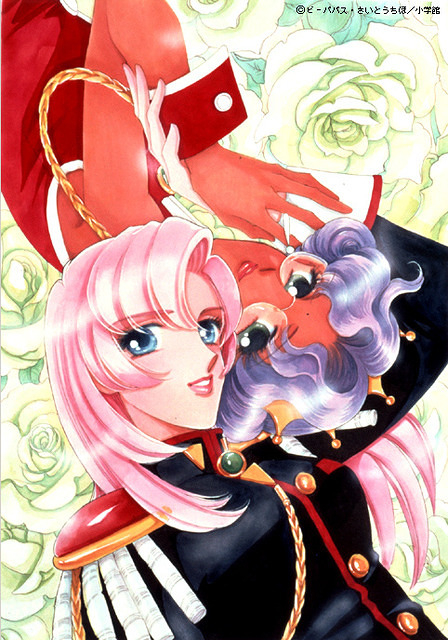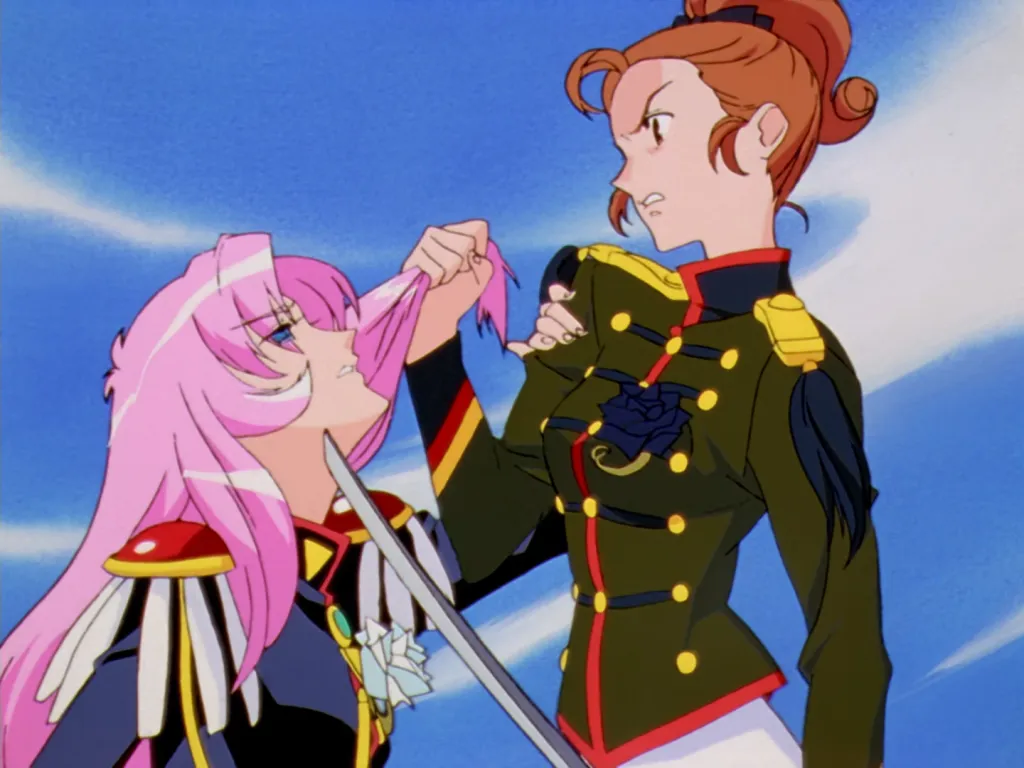
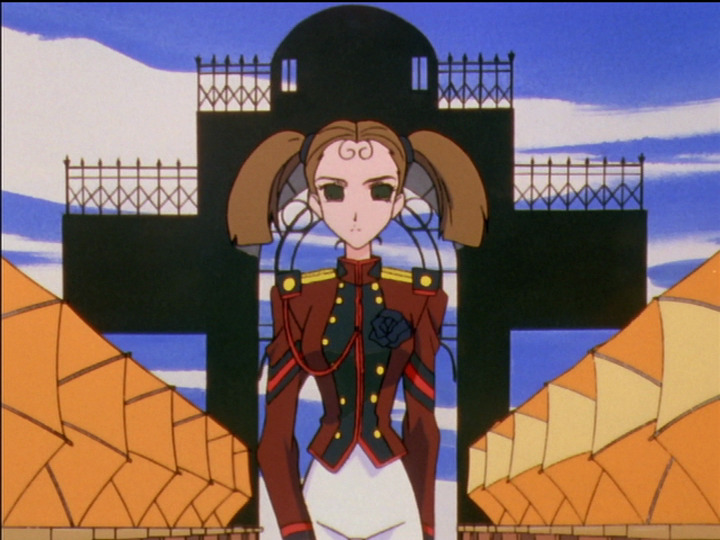
in the dueling arena, female black rose duelists wear the prince’s clothes: this gendered expression of power, which is so significant when utena does it outside the symbolic space, becomes natural, even from the most mundanely feminine women. I say mundanely feminine to emphasize that these are not women who feel any angst about being women. kouze, wakaba, keiko, kanae, and shiori may be tortued, they even may be tortured about the how the nature of their womanhood affects their relationship with other women (shiori being the most obvious, but think also of how any friendly relationship kouze may want from anthy is affected by the fact that she is another women in akio’s life, or how keiko is targeted by nanami in a way nanami would never target a man, or how wakaba’s feelings about anthy stealing saionji are clearly a projection of how she feels about anthy stealing utena which she cannot verbalize because she’s been raised to center male attention), but they never turn toward their own womanhood as the fault in the situation.
shiori, unlike juri, does not wish she were a man in her relations with juri. wakaba does not realize that it is masculine power which makes saionji and utena “special.” kouze does not wish that she could inherit directorship herself. and yet, they still wear a man’s clothes when they attack anthy for their woes. their one claim to specialness, to power, to autonomy, is in the clothes of male authority. unlike juri, nanami, and utena, however, they do this under a psychoanalytic trance: they are far from realizing this desire consciously. the black rose duelists will never get what they want because they do not realize that their only autonomy within the patriarchy comes though imitation of (juri and utena) or proximity to (nanami) male power.
what is so interesting about rgu is that this dance with masculinity/princehood that the women in the show do could so easily be painted as a kind of freudian penis envy: the more “mature” (“enlightened”?) female characters (juri and utena) are the ones who emulate masculinity the most, who are the most upfront about the fact that they wish they were a man in their dealings with other women. compare juri with tokiko: juri’s desire for masculinity, her frank analytic understanding of her lust for shiori, are what make her a duelist, while keiko’s passive femininity makes her so insignificant utena doesn’t know her name. however, ikuhara makes it clear that this understanding of the power of masculinity under the patriarchy is not real maturity, and in fact takes duelists even further from graduating ohtori. akio, the embodiment of a powerless child taking refuge in this abusive masculine authority, will never leave the school and never grow up. it is the realization that masculine authority will always be toxic which allows duelists to mature. nanami spends most of the show as the most childish duelist, the one who is years and years from graduating, but once she realizes that her proximity to touga’s power (the masculine safety of the patriarchal family system) will never serve her, she becomes clearly one of the most enlightened among them. the black rose duelists are so pathetic and hopeless in their dueling attempts not because they do not want to be men, but because they do not even realize that the world that they want to impress so badly wishes they were. juri, touga, saionji, and utena (for most of the show) trap themselves in an attempt to become what ohtori wishes they were: real men, princes. nanami and anthy, a little wiser in their way, accept that they will never be able to achieve this perverse ideal but, instead, attempt to find security by clinging to the coat tails of those in power.
dios presents the fantasy to the students of ohtori, the hope, that this power can be absolutely good, absolutely protecting, and absolutely eternal. a man has the power to stop something bad from ever happening again. when touga is a man like akio is, he will have absolute control over anyone who might hurt him and be absolutely safe. when utena is a man like the prince is, she will be able to save herself from the coffin and be absolutely safe. when anthy has a man like dios was, he will be able to keep the entire world away from them and they will be happy.
it is only by rejecting this power entirely, by recognizing that the prince is an impossible dream, that they can escape. utena realizes this when she sees that anthy will always be victimized by male oppression. on some level, this is the realization that the rose bride (who is every woman) will always be abused by the patriarchal society– on some level, utena’s realization is a theoretical one. but on a truer level it is the realization that anthy will always be abused. this is what it is to really love a woman as another woman: to realize that the way the world hurts her is so intolerable that it is better to enter the vast unknown than to abandon her in exchange a perfect, white picket fence life. to fall into the nothingness, the empty map of lesbian desire, and hope she will follow. it is better to free her and die than to live happily when she is trapped without you.