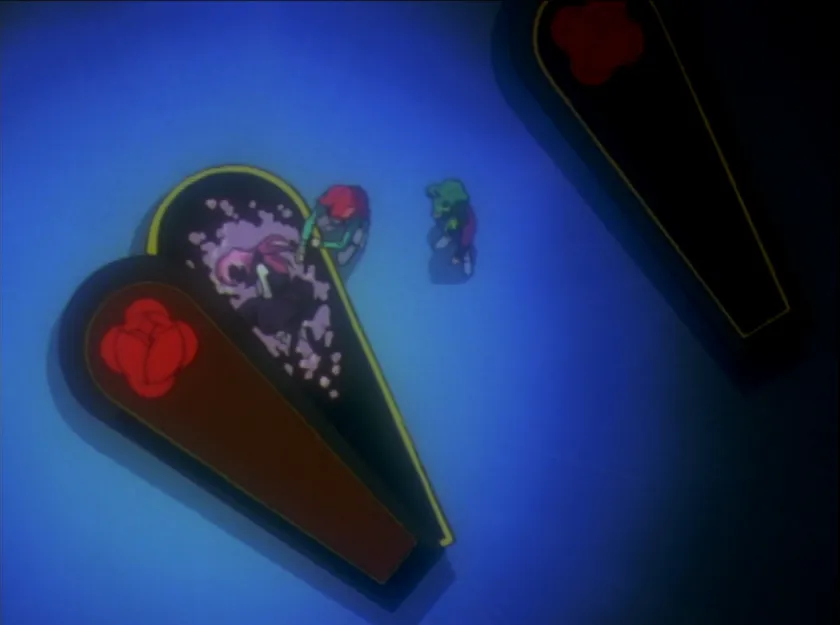
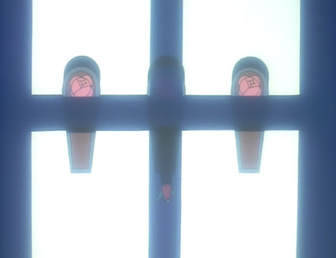
it is no accident that the students of ohtori are trapped in a coffin. a casket is the ultimate symbol not just of death, but of the mysticized societal response to death. when utena’s parents die, they go in the coffin. why should she not follow them? what is this coffin? she is unable to name the unspeakable fact that they are dead, so she can’t recognize the coffin she keeps herself trapped in. identically, she can’t recognize the heteropatriarchy– the social trappings of ohtori only allude to the unspeakable absolute violence of the rose bride, and so the adolescent students only stumble through them in confusion, feeling echos of sadism that they are unable to name. I mean unspeakable very literally: the projected world does not have a place for these truths. they only be implied, acted out, felt. they cannot be seen or spoken about without the entire system falling apart. when utena says but what will happen to himemiya? she speaks the unspeakable.
the feeling of having to break out of the egg (the coffin) is what drives the duelists forward. this is the death drive: the forward, feverish compulsion toward escape, power, confirmation of your mortality or lack thereof. it is the need to break out of the coffin that makes the duelists long for the miracle of eternity. (as a side note, the duelists all speak of ‘eternity’ differently: juri’s miracle, miki’s return to childhood, saionji’s desire for codependence, touga’s silence.) utena claims that this death drive is inextricably bound up in the patriarchy. on one side: reproduction/sex/love as a form of eternity and the subordination of women which results when sex is seen purely as a reproductive act and love as a hierarchical one. on the other: the horror of death and sex and desire for power as safety from it. all the duelists grapple with both, but we can see which weigh heavier on one side or another: saionji and juri flee toward eternity, touga and shiori seek the security of power. I think nanami could be read either way (give me your thoughts in the comments). there is a lot to be said in the place of this connection between the death drive and the patriarchy about how utena inferfaces with incest, but I’ll leave that for others.
in a bit of dramatic irony, dueling itself actually drives the duelists further into the coffin. the power of the prince and the castle of eternity are both mirages which the duelists chase on blind faith. a child believes wholeheartedly that the world cannot really be like this, the coffin cannot really be a constant threat, there must be a prince to save them from the horror of the world. a slim few (anthy, touga, akio) realize that there is no prince, but they realize too young and, unable to deal with that horror, desperately seek to accumulate power and become one, pulling others into the dueling system to convince themselves of a myth they can’t let go of but can’t make themselves believe.
when utena willingly gives up that myth for anthy, when she speaks the unspeakable into reality, when she looks the reality of the witch’s punishment in the face, that is when she escapes the coffin. and she can never return. It is further no coincidence, however, that sex is a car-- maybe Akio's car, like dueling, drives the duelists further into their coffins, but it is another sort of drive, a different harnessing of the death drive that will always stay with mortal women, which turns Utena into a car and gives Anthy the key. They are driven forward into freedom. Even your chains contain their own escape.